


Shakespeare’s Libraries
21.-23.04.2023 in Weimar.
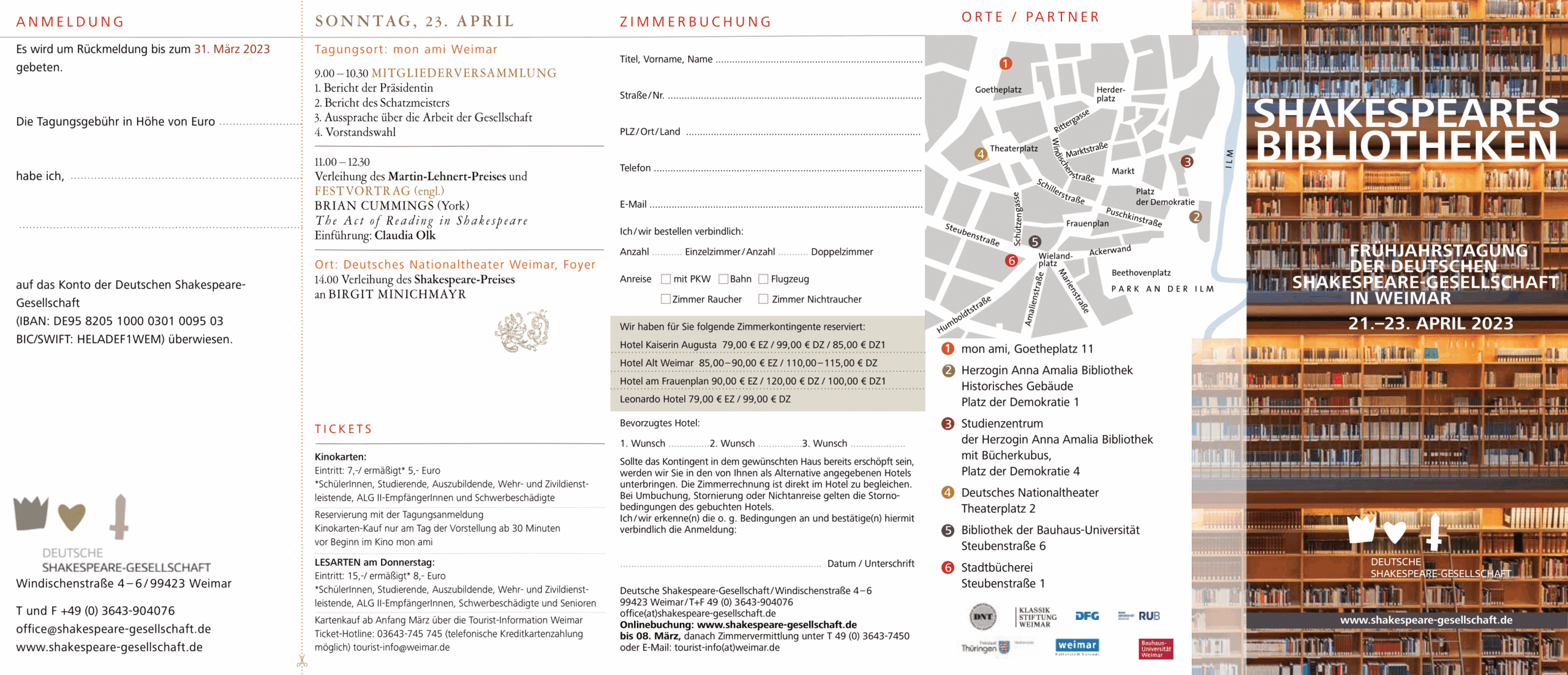
The first printed edition of Shakespeare’s collected plays was released in 1623 with the title Mr William Shakespeare’s Comedies, Histories, & Tragedies. Previously, only a few of Shakespeare’s plays had been published at all. Without the First Folio, large parts of Shakespeare’s works, like Macbeth or The Tempest, would probably have been lost – and with them countless words and idioms that have entered into the language usage of modern English. The history of the stages of the world, music, opera, film, ballet, literature and the fine arts would be a wholly different one. The German Shakespeare Society celebrates the 400th anniversary of the First Folio with a conference on Shakespeare’s Libraries.
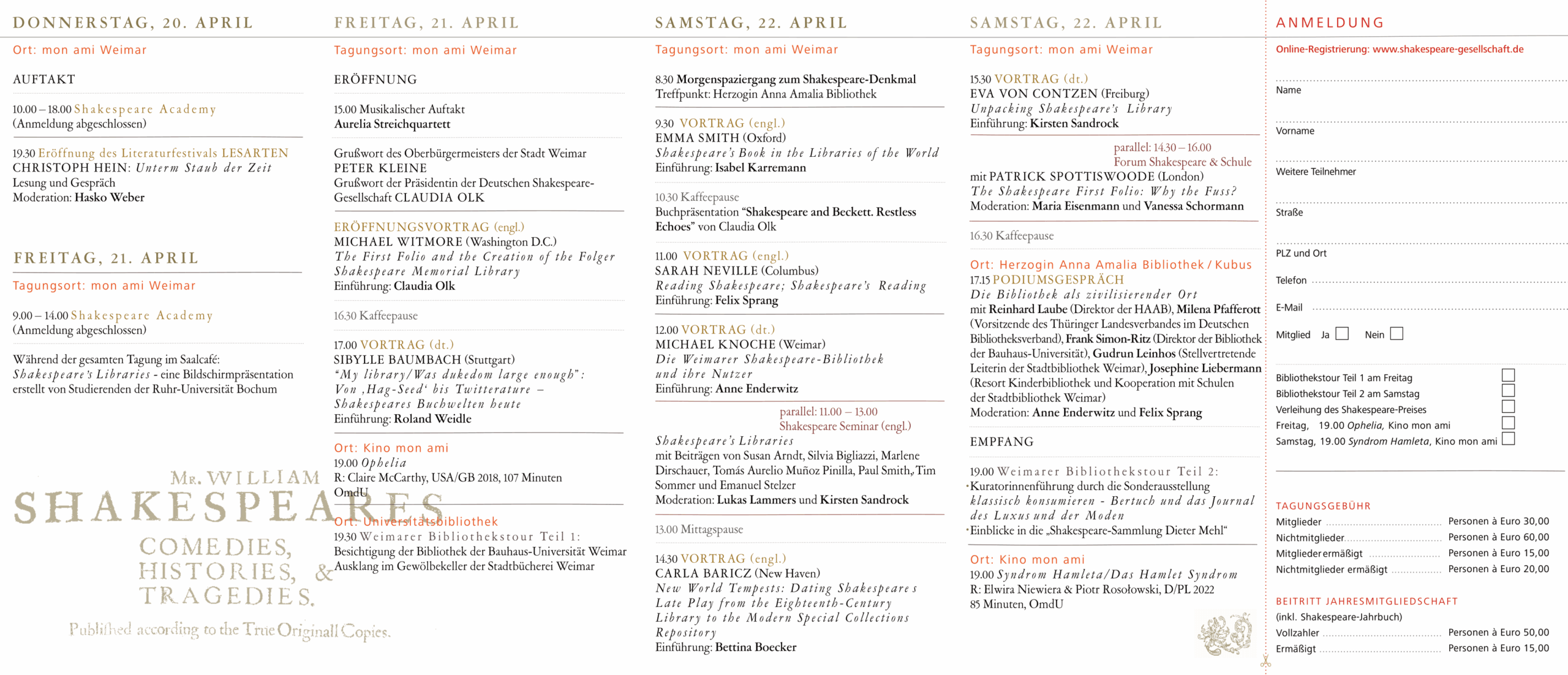
We are especially excited to announce that Prof. Dr. Michael Witmore, the director of the Folger Shakespeare Library in Washington, D.C., will be joining us for the conference. He will give the opening talk on “The First Folio and the Creation of the Folger Shakespeare Memorial Library”. The Folger Shakespeare Library holds the largest collection of Shakespeare and his contemporaries, with 82 First Folio editions and 60.000 Manuscripts.
Another contributor with a background in librarianship is Dr Carla Baricz (Sterlin Library, Yale). In her paper, she will focus on the dating of Shakespeare’s late work The Tempest and, in this context, trace the significance of historical library collections from the 18th century to the present. Prof. Dr. Sarah Neville (Ohio State University) dedicates her paper to the reading process of the works of Shakespeare and, in turn, to the written works that inspired Shakespeare’s authorship of his plays.
Prof. Dr. Emma Smith will be joining us from Oxford University. Her monograph Shakespeare’s First Folio: Four Centuries of an Iconic Book (Oxford University Press, 2016) is a reference work for Shakespeare studies and is relevant for the topic of our conference. Prof. Dr. Brian Cummings (University of York) will also be speaking in Weimar. At the moment, Prof. Cummings is working on a book-historical project that understands books both as objects of reverence and desire, as well as artefacts that give reason for anxiety and uncertainty. His work Bibliophobia, published in 2022, focuses on these aspects. With his paper „The Act of Reading Shakespeare“ he will take a reception-oriented perspective on the First Folio.
The excellent junior scholar Junprof. Dr. Eva von Contzen (Albert-Ludwigs-Universität Freiburg) will also be joining us in Weimar. In her paper titled “Unpacking Shakespeare’s Library”, she will examine Shakespeare’s sources, their use and systematisation. Furthermore, Prof. Dr. Sibylle Baumbach (Universität Stuttgart) will present her paper „My library/Was dukedom large enough“: Von ‚Hag-Seed‘ bis Twitterature – Shakespeares Buchwelten heute“ with regard to Shakespeare-adaptations in the digital sphere. Further, the director of the Herzogin Anna Amalia Library Weimar, Dr. Michael Knoche, will present a paper on the Weimar Shakespeare Library and its users.
The plenary talks of the yearly conference will be supplemented by the Shakespeare Seminar, in which PhD candidates and junior researchers present their own projects that engage with Shakespeare’s works and the English Renaissance.
Furthermore, the format „Shakespeare und Schule“ has found a fixed place on the yearly conference of the German Shakespeare Society to provide English teachers with a forum for exchange and to give new impulses for the curricular teaching of Shakespeare’s works in English class at German schools. For this, the German Shakespeare Society has invited the founder and former Director of the section „Globe Education“ at the Globe Theatre London, Patrick Spottiswoode. In his paper „The Shakespeare First Folio: Why the Fuss?“ he will explore the question, where our fascination for this exceptional book comes from.
This year’s Shakespeare Academy will already take place ahead of the conference, on the 20th and 21st of April. With a special focus on Shakespeare’s late work The Tempest, students will explore the text’s reflections on its own mediality, as well as the role of magical books which grant Prospero power on the actions on stage. Interested students can apply with a brief motivational letter (max. 1 page) to shakespeare-academy@anglistik.uni-muenchen.de by 12.02.23.
For the first time in the history of the German Shakespeare Society, the Shakepsare Prize of the German Shakespeare Society will be awarded on 23 April. This year, it will be awarded to actress and singer Birgit Minichmayr. In the future, the Shakespeare Prize will be awarded every other year to public persons who have engaged with Shakespeare’s work and contributed to its proliferation in exceptional ways.
Here you can download the Programme and the Presidents invitation . Here you can sign up online.
Abstracts
- Sibylle Baumbach (Stuttgart) “‘My library / Was dukedom large enough’: Von ‚Hag-Seed‘ bis Twitterature –Shakespeares Buchwelten heute”
- Carla Baricz (New Haven) “New World Tempests: Dating Shakespeare’s Late Play from the Eighteenth-Century Library to the Modern Special Collections Repository”
- Brian Cummings (York) “The Act of Reading in Shakespeare”
- Michael Knoche (Weimar) “Die Weimarer Shakespeare-Bibliothek und ihre Nutzer”
- Emma Smith (Oxford) “Shakespeare’s Book in the Libraries of the World”
- Eva von Contzen (Freiburg) Unpacking Shakespeare’s Library
- Michael Witmore (Washington D.C.) “The First Folio and the Creation of the Folger Shakespeare Library”