

FAQ Shakespeare Memorial in Weimar
Here you can find more information about the Shakespeare memorial, created by Otto Lessing in 1904. The memorial is located in Weimar in the Ilm Park.
Who commissioned the memorial?
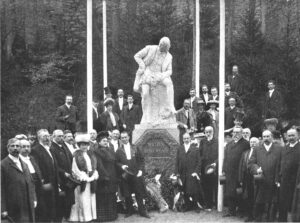
The Weimar Shakespeare memorial was commissioned by the German Shakespeare Society at the beginning of the 20th century and is the only Shakespeare memorial in mainland Europe to this day. The inauguration took place on 23 April 1904 on the 40th anniversary of the German Shakespeare Society – and on Shakespeare’s 340th birthday. Today, the statue belongs to the Klassik Stiftung Weimar, which collaborated with the Deutsche Stiftung Denkmalschutz to restore the statue in the 1990s. In 1999, the memorial was returned to its original location in Ilm Park.
What are the artistic peculiarities of the statue?
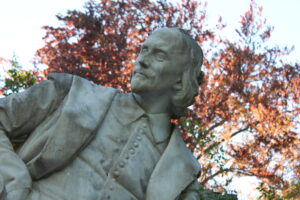
The statue was created from Carrara marble by Berlin sculptor Otto Lessing. It is over 2 metres tall and sits atop a 1,40-metre-high pedestal in front of an artificial ruin. Shakespeare casually sits on a base in historicised clothing, resting his right hand at his hip. In his right hand, he holds a scroll, in his left hand a rose twig. At his feet lie a laurel wreath, a dagger, and a skull wearing a fool’s cap. These attributes create tension between fame and transience, humour and melancholy. This emotional tension is reflected in Shakespeare’s face: depending on the viewer’s perspective, it looks like he is either serious or smirking slyly.
What is the tradition behind the morning walks to the statue?
Among the members of the German Shakespeare Society exists a long-standing tradition that is upheld during the conferences in Weimar: before the day’s conference programme begins, the Shakespeare enthusiasts gather for a morning walk to the Shakespeare monument in the Ilm Park. Balz Engler observes: “There is music; a speech is given that seeks to strike an appropriate balance between wit and seriousness and often sheds light on the history of the Shakespeare Society. No wreaths are laid anymore, no ribbons draped. Instead, the attendants bring a rose and try to outdo one another in originality in how they present it to Shakespeare at the monument.”
“’Der Stein Sich Leise Hebt’: Das Shakespeare-Denkmal in Weimar” by Balz Engler (2003)
In his contribution to the Shakespeare Yearbook (2003), Balz Engler discusses the memorial’s history as symptomatic of the changing Shakespeare reception in Germany. When the Shakespeare Society first commissioned the project at the beginning of the 20th century, the memorial was intended to position Shakespeare alongside Goethe and Schiller as the third classical author. Otto Lessing, however, conceptualised Shakespeare as a Romantic author and insisted on the statue’s placement in the Ilm Park. There, it was subjected to the weather and vandalism for many decades. During the GDR, it was moved closer to the Weimar market square for ideological reasons. In 1964, the statue returned to its original spot in the Ilm Park and is now a part of an ensemble of further memorials of Pushkin, Mickiewicz and Petöfi. You can read an edited version of Balz Engler’s article here (German with English summary at the end).
Here you can listen to a speech by Frank Günther (1947 – 2020), one of the most renowned Shakespeare translators of our time. The speech was held during the morning walk to the Shakespeare statue during the anniversary conference in 2014:
Sources
Deutsche Stiftung Denkmalschutz: Shakespeare-Denkmal
Literaturland Thüringen: William-Shakespeare-Denkmal in Weimar